Some days, a walk just isn't happening. Maybe the pavement's too hot to touch. Maybe it's sheet rain and forty-mile-an-hour winds. Maybe you've got a dog recovering from surgery, or you're the one on the sofa with a cold and a box of tissues. Or maybe life has simply got in the way and the gap in your day you'd planned for a walk has disappeared.
It happens to every dog owner. And here's the thing: missing the odd walk isn't a failure. Dogs don't need a five-mile hike every day to be happy. What they need is engagement: something to do with their brain and their nose, a bit of physical movement, and your attention.
I'm a dog walker by trade, so I spend most of my week outdoors with dogs. But even I have days where a full walk isn't possible, whether that's because of the heat, the weather, or a dog in my care who's on restricted exercise. Over the years I've built up a reliable set of indoor activities that tire a dog out mentally when physical exercise isn't on the cards. These are the ten I reach for most often.
A quick note: every dog is different. A game that one dog finds thrilling will bore another. A food puzzle that takes one dog five minutes will stump another for half an hour. Work through the list, find what clicks with your dog, and remember that a focused brain-work session is genuinely mentally engaging; many dogs are noticeably ready to settle afterwards..
And if you're reading this because you're genuinely stuck (an injury, a new baby, a work deadline that's eaten your week) I do solo walks, small group walks, and in-home dog sitting across Taunton and the surrounding villages. Sometimes the best enrichment activity is someone else handling the walk while you get your breath back. And when you are ready to get back out there, here are the best dog walking spots in and around Taunton.
1. Scent Work: The Fifteen-Minute Nose Workout
If you do one thing from this list, do this one. A dog's nose is its primary way of understanding the world, and scent work uses a part of the brain that physical exercise barely touches. Ten to fifteen minutes of focused sniffing is genuinely mentally demanding; many dogs are noticeably ready to settle afterwards.
What you need: A handful of your dog's regular kibble or some small treats, and a room with hiding spots.
How to do it: Put your dog in another room (or a stay if they have one). Hide treats at varying heights: under furniture edges, behind door frames, on low window ledges, tucked into the folds of a blanket. Start easy (visible, floor level) and get harder as your dog figures out the game. Release them with a cue like "find it" and let them work the room.
Time: 10–15 minutes.
Good for: All dogs, but especially scent-driven breeds like spaniels, beagles, and labradors.
The first few times, keep it simple. You're teaching your dog how to play the game, not testing them. Once they understand "find it," you can make hides progressively harder: inside a cardboard box, under a cushion, on a chair seat. A dog who's been scenting hard for fifteen minutes will often flop down and sleep afterwards, which is exactly the point.
2. Puzzle Feeders: Meals That Work for a Living
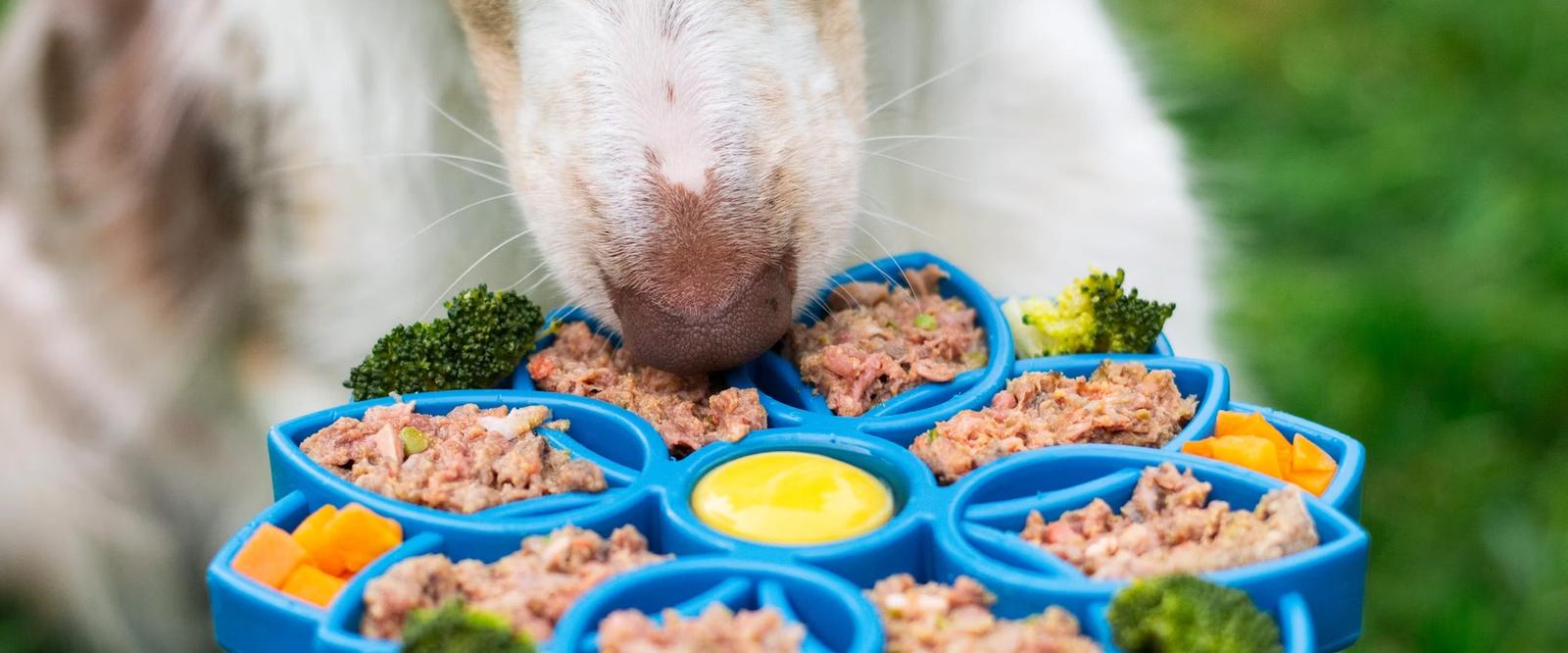
If your dog eats from a bowl twice a day, you're sitting on the easiest enrichment upgrade there is. Turning mealtimes into a puzzle achieves two things at once: your dog gets fed and mentally exercised, and you don't need to carve out extra time.
What you need: A puzzle feeder, slow feeder bowl, snuffle mat, or a rolled-up towel.
How to do it: Replace the bowl with something that makes your dog work for their food. A snuffle mat (fleece strips on a rubber base) is the simplest: scatter the kibble through the mat and let your dog snuffle it out. A rolled towel works the same way: spread kibble across a towel, roll it up lengthways, and tie it in a loose knot.
Time: 10–20 minutes depending on the puzzle and your dog.
Good for: Dogs who wolf their food, dogs who need more mental stimulation generally, and any day when you're short on time.
If you don't own a puzzle feeder, start with the towel trick today. It costs nothing and works immediately. If your dog takes to it, a proper snuffle mat or a Nina Ottosson-style puzzle board is worth the investment. They're designed to be washed and they'll last years.
3. Trick Training: Ten Minutes That Changes Your Dog's Brain
People think of trick training as something you do for fun, or to show off at parties. It's that, but it's also one of the most efficient ways to tire a dog out mentally. Learning a new behaviour requires concentration, frustration tolerance, and problem-solving. All of which use serious brainpower.
What you need: Treats (something good, like cheese, chicken, or dried liver), a clicker if you use one, and a quiet space.
How to do it: Pick one new trick and work on it for 5–10 minutes. Keep sessions short and end on a win, even if it's a small one. Good starter tricks: spin, paw, weave through legs, touch a target, put your paws up on a low stool, or roll over.
Time: 5–10 minutes per session, 1–3 sessions spread through the day.
Good for: Any dog who's food-motivated. Particularly good for working breeds who need a job: collies, shepherds, spaniels, poodles.
Don't drill. Three or four good repetitions and a jackpot reward is better than twenty sloppy ones while your dog loses interest. Short, successful sessions build enthusiasm for the next one.
If you want to take this further, I offer Heelwork to Music training (think: dog dancing with training foundations) and Agility training for dogs who love to move and learn. Both are brilliant for dogs who need more than a walk can give them.
4. Hide and Seek: The Game That Every Dog Understands
Hide and seek needs no equipment, no training, and about thirty seconds to explain. It combines scent work, movement, and the joy of finding their favourite person. If you have kids, bring them in on this one. Dogs and children both love it.
What you need: A house with at least a few rooms, and ideally a second person to hold the dog.
How to do it: Have someone hold your dog (or put them in a stay) while you hide. Call them once from your hiding spot, then stay quiet. When they find you, celebrate like they've won the lottery. Treats, fuss, the works. Repeat.
Time: 10–15 minutes.
Good for: Dogs with good recall, dogs who are people-oriented, and dogs who need a confidence boost.
Start with easy hides (behind a door, around a corner) and make them progressively harder as your dog gets the idea. A dog who runs past your hiding spot and has to double back is using their nose and their brain in exactly the way that produces a tired, contented dog.
5. The Cup Game: Find the Treat
This is the classic shell game, adapted for dogs. You hide a treat under one of three cups, shuffle them around, and let your dog figure out which one it's under. It looks simple, but for a dog using their nose to solve the puzzle, it's proper brain work. And it needs zero equipment beyond what's already in your kitchen cupboard.
What you need: Three opaque cups (paper cups, plastic beakers, or mugs all work), plus a few small, smelly treats.
How to do it: Put your dog in a stay or have someone hold them. Place the three cups upside down in a row and let your dog watch as you put a treat under one of them. Give your release cue and let them sniff it out. When they indicate the right cup (a nose bump, a paw, or just staring at it), lift it and let them have the treat with plenty of praise. Once they understand the game, start shuffling the cups slowly after hiding the treat. Keep it easy at first. The goal is to build confidence, not to outsmart them.
Time: 10–15 minutes.
Good for: All dogs. Especially good for dogs on restricted exercise, senior dogs, and puppies who can't do anything high-impact. Also brilliant for building confidence in shy or anxious dogs.
Level up: Once your dog has the hang of three cups, add a fourth. Or hide the treat without them watching so they have to rely entirely on their nose. Some dogs get so into this game they'll keep playing long after you've run out of treats, which tells you everything you need to know about how much dogs love using their nose.
The cup game followed by a frozen Kong (see activity 7) is a lovely low-key combination for rainy afternoons. Sniff first, lick later. Both activities are calming, both use the brain, and your dog will almost certainly be asleep within twenty minutes of finishing.
6. The Sniffari: When a Short Walk Is Better Than No Walk
A "sniffari" is my term for a walk where the goal isn't distance or exercise. It's smelling things. You go at your dog's pace, you stop whenever they want to sniff, and you don't worry about covering ground. It's the opposite of a power walk.
What you need: A lead (a longer one is better, a 5-metre training line gives them room to roam), and a patch of grass, a verge, a quiet street, or even just the front garden.
How to do it: Take your dog to any outdoor space, however small, and let them lead. Don't rush. Don't pull. Stand there while they investigate a single fascinating blade of grass for forty-five seconds. The sniffing is the point.
Time: 10–20 minutes.
Good for: Hot days (go early or late, stay on grass), cold days (wrap up and keep it short), dogs on restricted exercise, and days when you haven't got the energy for a full walk.
A sniffari works because sniffing is how dogs process information. It satisfies a fundamental need that a brisk lead walk often doesn't, sniffing is how dogs process information about their world, and a dog who's been given space to sniff is a calmer, more contented dog.. If your garden is secure, letting your dog out to sniff around for fifteen minutes while you sit with a cup of tea counts. Honestly.
7. Lick Mats and Frozen Kongs: The Calm-Down Classic
Licking is a self-soothing behaviour for dogs. It's a calming, self-soothing behaviour, which is why a dog who's overexcited, anxious, or frustrated will often settle dramatically after ten minutes with a lick mat or a stuffed Kong. It's also genuinely tiring in a low-key, sustained way.
What you need: A lick mat (textured silicone mat with grooves), a classic Kong, or anything food-safe with a textured surface that takes time to clean. Plus something spreadable: yoghurt, peanut butter (check the label for xylitol), wet dog food, mashed banana, or cottage cheese.
How to do it: Spread the food across the mat or stuff it into a Kong. For a longer-lasting version, freeze it. A frozen Kong takes most dogs 20–40 minutes to work through, compared to 5–10 minutes for room-temperature.
Time: 10–40 minutes depending on whether it's frozen.
Good for: Dogs who struggle to settle, dogs who are anxious, dogs on crate rest, and any time you need your dog to be calm and occupied for half an hour.
Keep a couple of stuffed Kongs in the freezer at all times. They're the closest thing to a pause button you'll get with a restless dog, and they work in almost any scenario: post-surgery recovery, thunderstorm anxiety, or just a Tuesday afternoon when you need to get some work done.
8. Indoor Obstacle Course: Furniture, Forts, and Fun
You don't need agility equipment to give your dog a physical workout indoors. A hallway, some furniture, and a bit of creativity is all it takes. This one's particularly good if you have children, because building the course is half the fun.
What you need: Cushions, chairs, blankets, a broom handle across two low stacks of books, an open cardboard box. Whatever you have.
How to do it: Set up a simple course: weave between chair legs, jump over a cushion (low), crawl under a blanket draped between two chairs, walk through an open cardboard box tunnel, pause on a mat. Lead your dog through it on a treat lure the first few times, then gradually fade the lure so they're following your hand or a verbal cue.
Time: 10–15 minutes.
Good for: Confident dogs who enjoy physical challenges, young dogs, and dogs who already know some basic cues.
Watch out for: Slippery floors. Put down a rug, a yoga mat, or some non-slip matting. A dog who skids into a chair leg will be reluctant next time. Keep jumps low (elbow height or below) and skip jumping entirely for puppies, seniors, and long-backed breeds like dachshunds and corgis.
This isn't about building an impressive course. It's about giving your dog something novel to navigate and think about. A cardboard box with both ends open, placed in a doorway, is an obstacle. Walking through it on cue is a task. That's enough.
9. Structured Tug and Play: Rules Make It Tiring
Tug is one of the best indoor energy-burners there is, provided you play it with rules. Unstructured tug, where you just yank on a toy, is fine. But it doesn't engage your dog's brain. Add rules and it becomes a training session.
What you need: A tug toy. A long fleece tug or a rope toy works well. Something that gives your hand some distance from your dog's mouth.
How to do it: The rules: your dog only grabs the toy when you give a cue ("take it"). They must release when you ask ("drop" or "out"). If teeth touch skin, the game stops immediately for thirty seconds. Tug for 20–30 seconds, ask for a release, reward with a treat or by restarting the game. The stop-start pattern teaches impulse control while burning physical energy.
Time: 5–10 minutes of structured play, 2–3 rounds.
Good for: Dogs who love to tug, dogs working on impulse control, and dogs who need to learn a reliable "drop."
Watch out for: Dogs with neck or spine issues, and dogs who get over-aroused by tug. If your dog can't take a treat or respond to a known cue during play, they're too aroused. Take a break and try again when they're calmer.
If your dog doesn't have a solid "drop" yet, don't worry. The game itself will teach it, because the fastest way back to tugging is letting go when asked. Use a second toy as a backup: show the spare, and most dogs will drop the first one to grab the new one. Mark and reward that.
10. The Settle: Teaching "Doing Nothing" as a Skill
This one doesn't look like an activity, and that's the point. For a lot of dogs (especially young ones, working breeds, and dogs who've learned that movement equals stimulation) the hardest thing in the world is doing nothing. Teaching a dog to settle on cue is a genuine life skill, and it's mentally tiring in a way that surprises people.
What you need: A mat, blanket, or dog bed, and a supply of treats.
How to do it: Put the mat down and reward your dog for any interaction with it: looking at it, stepping on it, standing on it. Shape towards lying down on the mat, then towards staying there while you gradually extend the duration. The goal is a dog who can lie on their mat and relax while life happens around them, whether you're working, eating dinner, or watching TV.
Time: Start with 2–3 minute sessions and build up over weeks.
Good for: Every dog. Particularly transformative for dogs who pace, demand-bark, or can't switch off.
The settle is the skill behind all the other activities on this list. A dog who can settle is a dog who doesn't need to be actively entertained every waking moment. It's also the skill that makes everything else in your life with a dog easier: café visits, vet waiting rooms, having guests over, working from home.
Start small. Reward calmness whenever you see it, not just during training sessions. A dog who chooses to lie down and relax, even for thirty seconds, has just done something worth reinforcing.
Practical Tips for No-Walk Days
Short sessions add up. Three ten-minute activities spread across the day are better than one thirty-minute block. Dogs, like people, benefit from breaks.
Use their meals. The easiest way to fit enrichment into a busy day is to stop feeding from a bowl. A snuffle mat at breakfast, a puzzle feeder at dinner. You've added two mental workouts without finding any extra time.
Watch for over-tiredness. A dog who's mentally exhausted can look a lot like a dog who needs more exercise: pacing, panting, unable to settle. If your dog seems restless after an enrichment session, try a frozen Kong or a lick mat. The sustained licking helps them transition into rest.
Hot pavement is dangerous. If you're skipping a walk because of heat, you're doing the right thing. Press the back of your hand against the pavement for five seconds. If it's uncomfortable for you, it's too hot for your dog's pads. Early morning and late evening are your windows on hot days. See the sniffari section above for more on this.
Recovery isn't a setback. If your dog is on restricted exercise after surgery or injury, the mental enrichment on this list isn't a consolation prize. It's genuinely what they need. A dog whose brain is tired copes better with crate rest and lead-only toilet breaks.
You're not a bad owner. Missing walks happens. Stressing about it doesn't help you or your dog. A dog who's fed, safe, loved, and given something to think about is a dog who's doing just fine.
Want someone else to do the walking?
Hi, I'm Emma, the dog walker and trainer behind Dogs and Fairy Tails, based in Taunton. I run solo walks, small group walks, and in-home dog sitting across Taunton and the surrounding villages. I'm BSc Animal Behaviour qualified, fully insured, DBS checked, and I compete at Crufts in Heelwork to Music and Agility. So whether your dog needs a gentle lead walk, an energetic group run, or a calm companion while you're away, they're in good hands.
If you're recovering, overwhelmed, or just need a day where someone else takes the lead, book a free meet and greet and we'll work out the right walk for your dog. Or if you'd like to know more about me first, here's the about page.